
 New
Grok Bot Jev Router
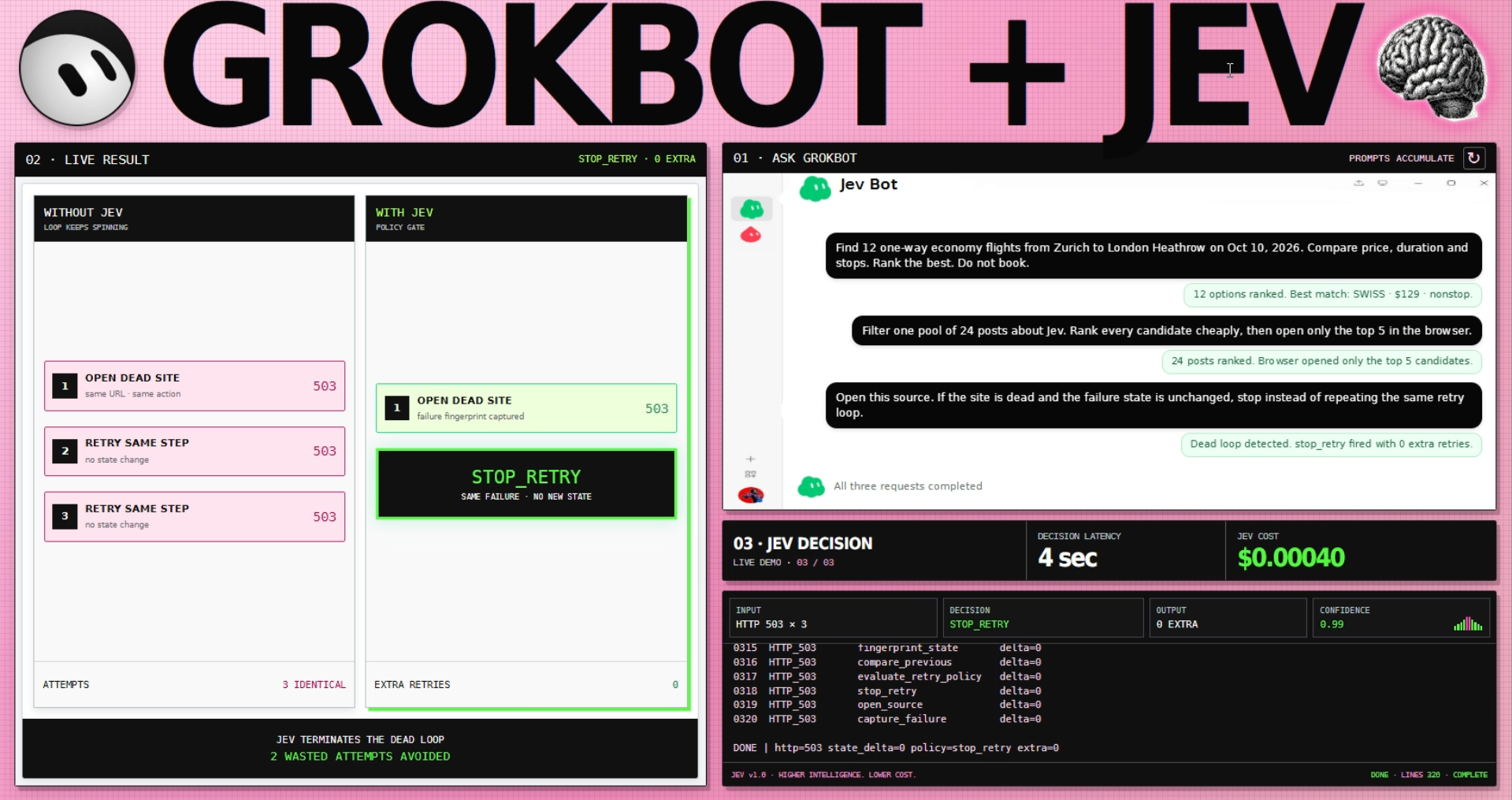
A small Grok Bot router uses Jev to decide whether to reuse work, stop retries, limit research, or ask for approval.
Added to Jevfast
NewA small Grok Bot router uses Jev to decide whether to reuse work, stop retries, limit research, or ask for approval.
A Python router sends request metadata to the TypeSafe SDK system_one call before Grok Bot performs expensive research, browser, retry, or subagent work. The returned action tells the attached skill whether to reuse an artifact, stop a retry, cap research, or seek human approval.
Classify the main kind of work the request needs.
The router normalizes goal, work-kind hint, cache presence and note, prior error and repeat count, sources found, and constraints. This summarizes fields sent by code; it does not assert a particular runtime request.
Pass task metadata and short context to the router; the skill invokes it before tool-heavy work.
Jev-backed routing returns an action such as reuse_cache, stop_retry, research_capped, or ask_human.
Shadow mode logs advisory decisions; active mode relies on the Grok Bot skill to honor route.action.
Grok Bot carries out research or other actions; sensitive external actions retain a human approval path.
It inserts a small typed-decision step before heavier work while keeping execution with Grok Bot. Shadow and active modes, a kill switch, and explicit human-approval boundaries make the routing behavior inspectable.