Small decisions. Interesting possibilities.Submit contentSubmit
Jev Explained Playground preview

Jev Explained Playground

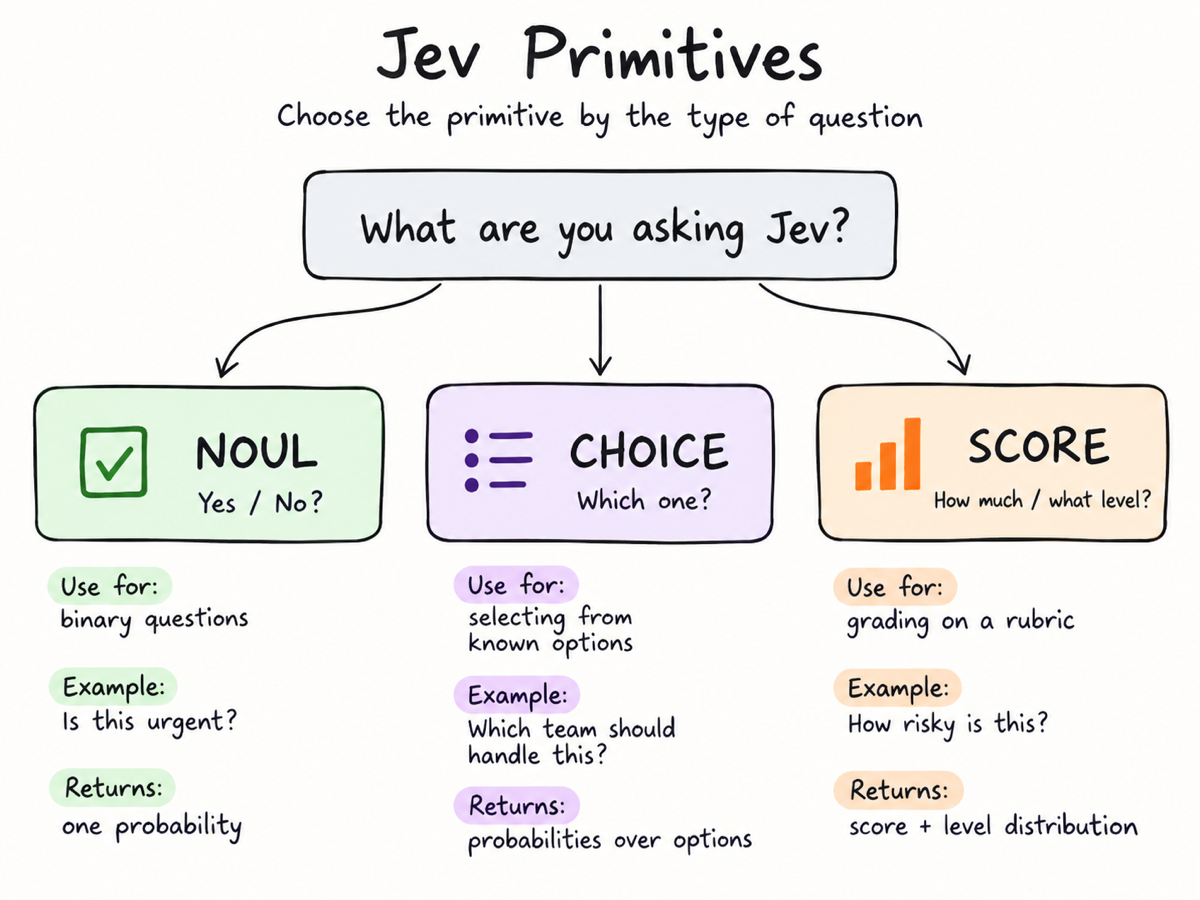
The examples make the boundary between classification and action concrete: Jev supplies typed probabilities, while ordinary application code applies thresholds, confidence checks, and human-review branches.

Added to Jevfast

How it uses Jev

The playground sends a user-editable text or JSON state and one or more typed Noul, Choice, or Score questions through its API proxy. It displays Jev's answer and probabilities, then runs example-specific application code over the typed answers to show what a consumer might do. The page is an interactive teaching demonstration; its configured sample states and outcomes are not records of observed production calls.

What Jev decides

Example: classify a suspicious emailExample answers · not a recorded Jev response · Source ↗
Question 1 · is spam
YOUR APP
INSTRUCTION

Is this email spam or phishing?

STATE

The pinned email-spam example includes sender, subject, body and a verification URL; it also defines coworker and newsletter alternatives.

JEV · NOUL
YesNo
Question 2 · folder
YOUR APP
INSTRUCTION

Which folder should receive the email?

STATE

The pinned email-spam example includes sender, subject, body and a verification URL; it also defines coworker and newsletter alternatives.

JEV · CHOICE
  1. inbox
  2. promotions
  3. spam

App workflow

  1. Choose or edit an example

    The user selects an example and can change its sample state or questions in the playground.

  2. Send the request

    The browser posts model, parsed text/JSON state, and named typed questions to the local API route; the route proxies to the selected provider.

  3. Inspect answers and example decision

    The workbench displays response details and passes typed answers into the example's decide function for its illustrative downstream result.

Why it is interesting

The examples make the boundary between classification and action concrete: Jev supplies typed probabilities, while ordinary application code applies thresholds, confidence checks, and human-review branches. One request can ask several distinct questions over the same state.