
 New
NewJev Judge MCP
Give coding agents bounded Jev judgment tools with local confidence and escalation policies.
Added to Jevfast
NewGive coding agents bounded Jev judgment tools with local confidence and escalation policies.
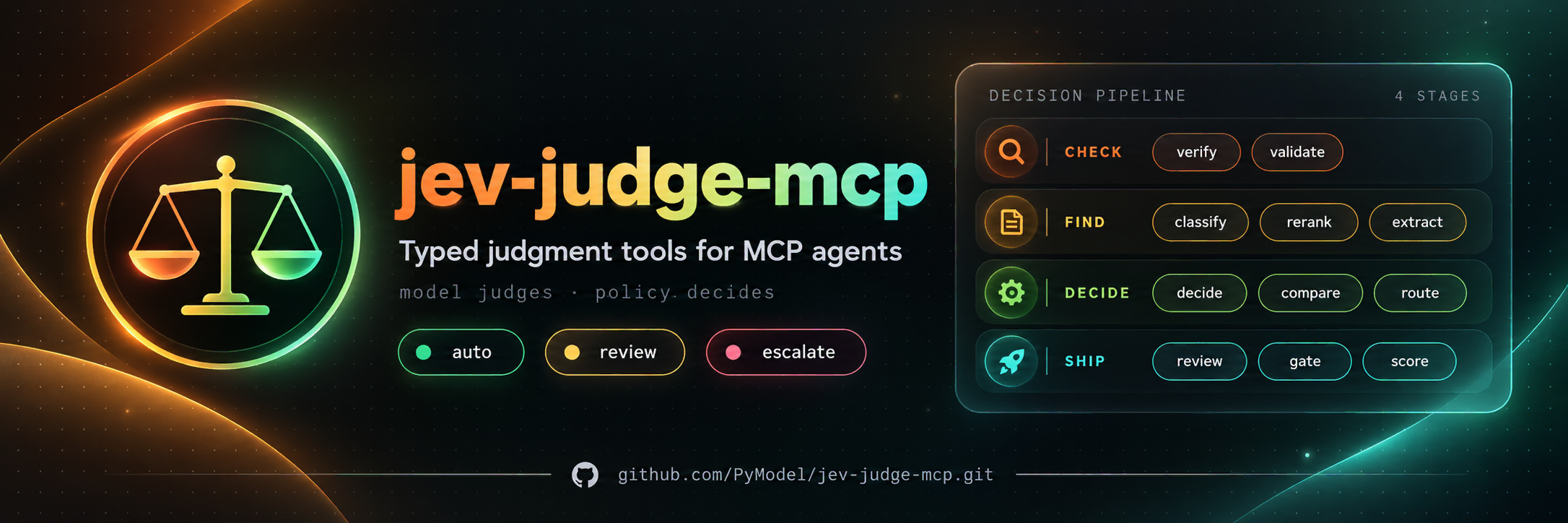
The MCP server exposes bounded judgment tools to an agent. A concrete jev_compare request supplies two passages, a purpose, and named aspects; the server asks Jev to classify the overall relation and each aspect as same_fact, contradicts, or different_facts. Server policy then turns the returned probabilities and margins into auto, review, or escalation actions. The tool result is structured judgment data, not generated prose.
Classify whether the two passages state the same underlying fact, contradict each other, or discuss different facts.
A repository-owned live comparison fixture contains two Dublin weather passages for 4 April 2024. City, date, high temperature, wind, and humidity are the requested aspects. This is a source-defined example request; the selected answer below is illustrative, not the fixture's observed live response.
Compare only the humidity aspect and choose agreement, contradiction, or non-overlapping facts.
A repository-owned live comparison fixture contains two Dublin weather passages for 4 April 2024. City, date, high temperature, wind, and humidity are the requested aspects. This is a source-defined example request; the selected answer below is illustrative, not the fixture's observed live response.
The setup and installer commands verify a TypeSafe key and register the version-pinned MCP server with the selected coding agent.
The agent chooses an exposed jev_* tool for existing evidence and an enumerable question; tool schemas validate the supplied arguments.
The server constructs fixed-choice, Noul, or Score questions from the tool input and sends state plus questions to the configured Jev provider.
The server validates typed answers and probabilities, then applies confidence, margin, thresholds, and fail-closed rules to produce an action.
The MCP tool returns the judgment, probability details, and policy action to the calling agent for its next step.
The project packages typed Jev decisions as ordinary agent tools and keeps model judgments separate from deterministic policy. Its comparison workflow can surface a contradiction in one aspect even when the overall comparison remains uncertain, allowing policy to route the result for review.