
 New
NewJev-Mem
Uses fast decisions to organize memory and guide retrieval for long-running agents.
Added to Jevfast
NewUses fast decisions to organize memory and guide retrieval for long-running agents.
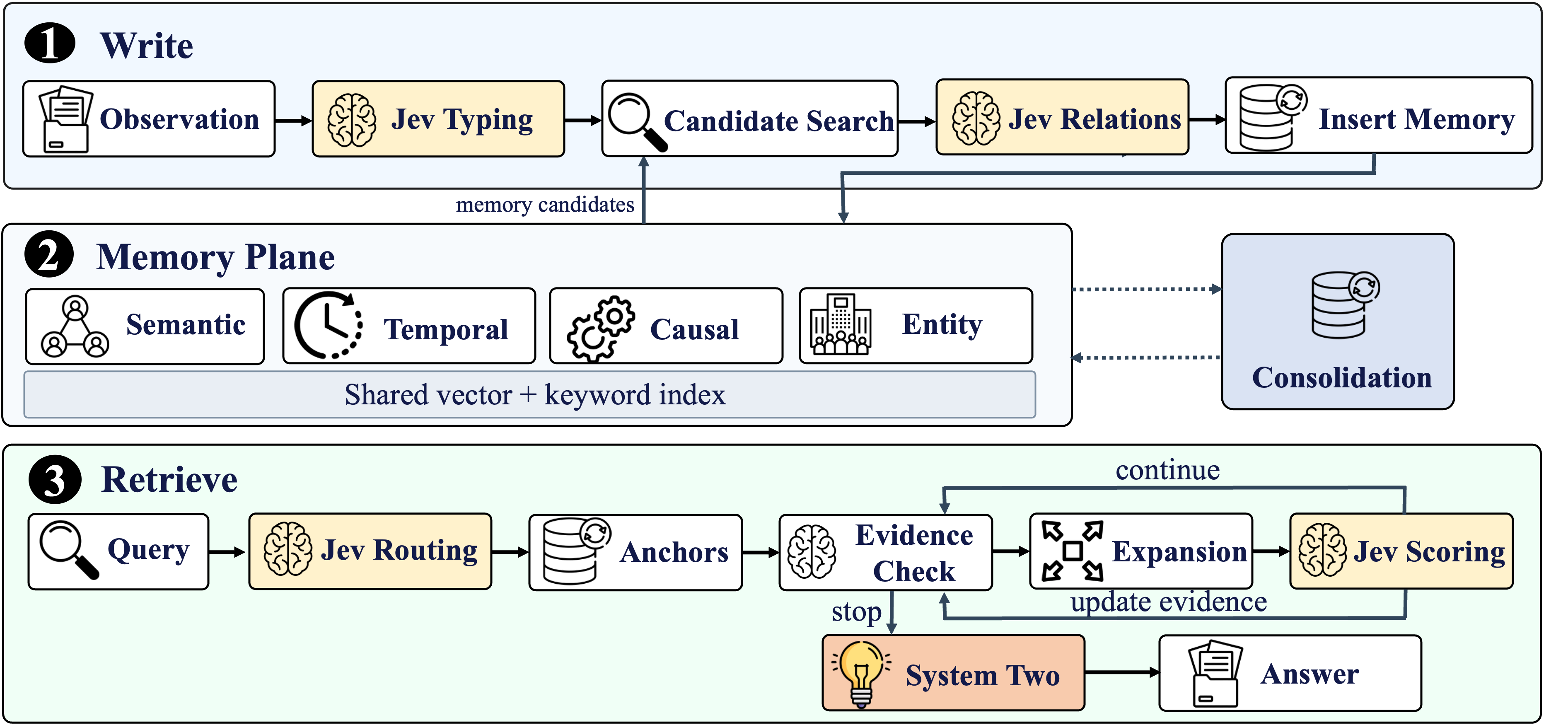
Jev-Mem puts typed Jev decisions around an agent memory graph. On a new observation it batches admission and memory-type Noul questions; for a user query it routes retrieval and tests whether gathered evidence is sufficient before a separate language model writes an answer.
Does this observation contain a detail worth retaining for future recall?
observation text, exact_duplicate flag and recent_memories list from the memory policy.
Does it describe a meaningful life event, goal, relationship, constraint or stable preference?
observation text, exact_duplicate flag and recent_memories list from the memory policy.
Does it add a fact absent from recent memories?
observation text, exact_duplicate flag and recent_memories list from the memory policy.
Does it describe a particular experience or event?
observation text, exact_duplicate flag and recent_memories list from the memory policy.
Does it state a durable fact about an entity or the world?
observation text, exact_duplicate flag and recent_memories list from the memory policy.
Send the observation, duplicate flag and recent memories through the Jev admission and type question set.
Store qualifying observations and use Jev to judge links, retrieval routes and candidate relevance.
Jev checks sufficiency or retrieval stopping; a separate language model synthesizes the final answer from selected memories.
It separates frequent bounded memory-management and retrieval judgments from the slower generative answer step, with explicit questions about novelty, relevance, and evidence sufficiency.