
 New
Jev Trip
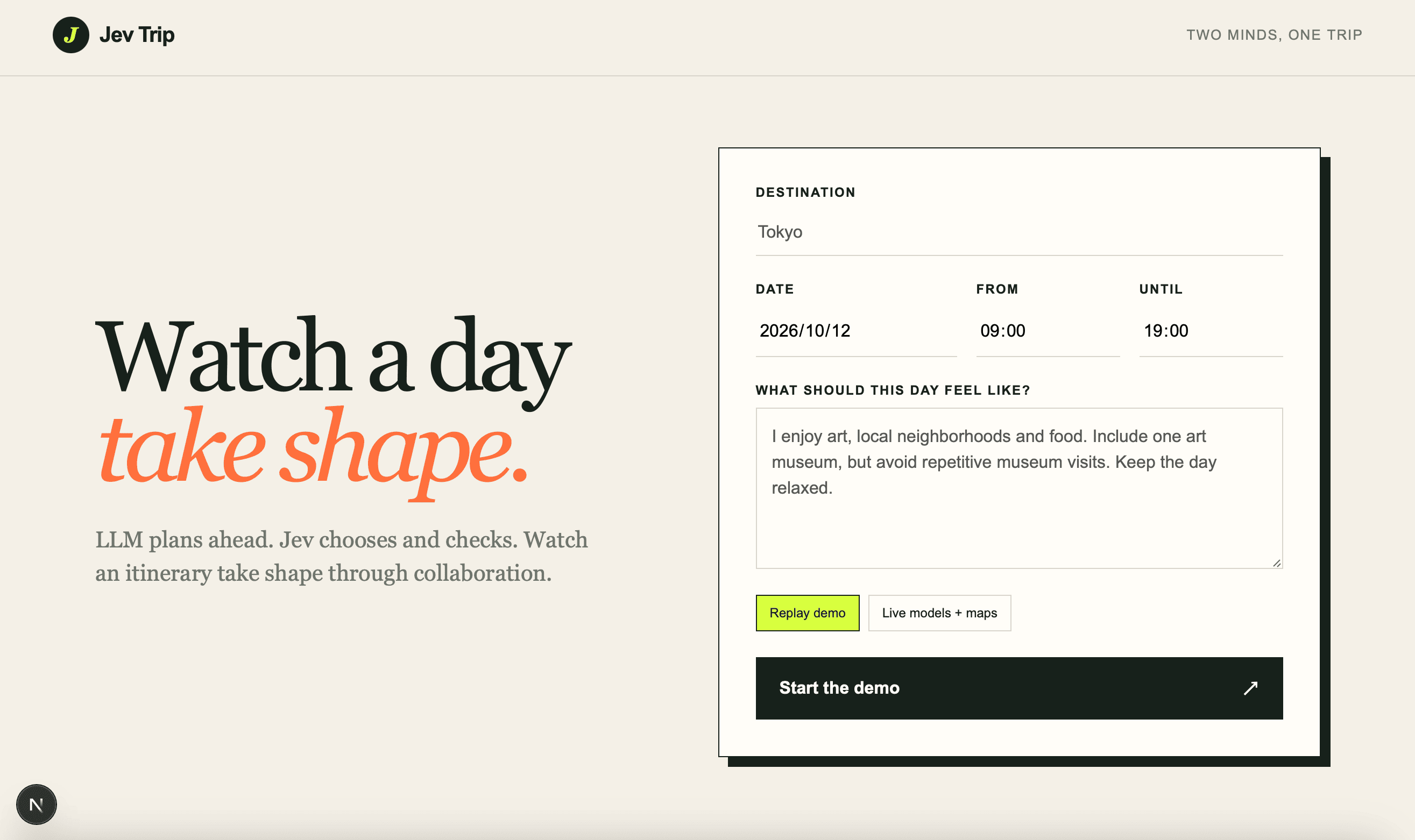
A day-trip planner where a language model drafts and Jev screens the request, places, transport options and plan steps.
Added to Jevfast
NewA day-trip planner where a language model drafts and Jev screens the request, places, transport options and plan steps.
Before planning, three choice questions check the request: whether it spans more than one day, more than one city, or asks for a booking. During planning, place candidates, transport options and finished plan steps are each checked by a choice question answering pass, flag or unknown against the stated preferences. The controller acts only on an answer whose confidence clears its threshold.
Does the user explicitly request an itinerary spanning more than one calendar day, judged from the meaning of the preference rather than isolated numbers?
The state is the user's trip preference text. Three choice questions answer pass, flag or unknown, and a flag at or above 0.75 confidence blocks the request with a scope message.
Does the user ask the product to execute a booking, reservation, purchase, payment, cancellation or order, rather than to recommend places?
The state is the user's trip preference text. Three choice questions answer pass, flag or unknown, and a flag at or above 0.75 confidence blocks the request with a scope message.
Three choice questions decide whether the ask is in scope; a confident flag returns a scope message instead of a plan.
The controller fetches places and walking or transit routes from the map provider; times and numbers are computed in code, not by a model.
A language model proposes the next activity and repairs steps the checks flagged.
Place, transport and plan-step questions judge fit, repetition and pace; an answer below the actionable confidence becomes unknown.
Code validates times, routes and versions, then streams the itinerary with each decision and its reason.
Deterministic code keeps the facts, routes and versions while Jev judges only what needs meaning, and a low-confidence answer becomes unknown instead of passing silently.