
 New
NewJeview
A local proxy and live visualizer for Jev decisions and their conditional follow-ups.
Added to Jevfast
NewA local proxy and live visualizer for Jev decisions and their conditional follow-ups.
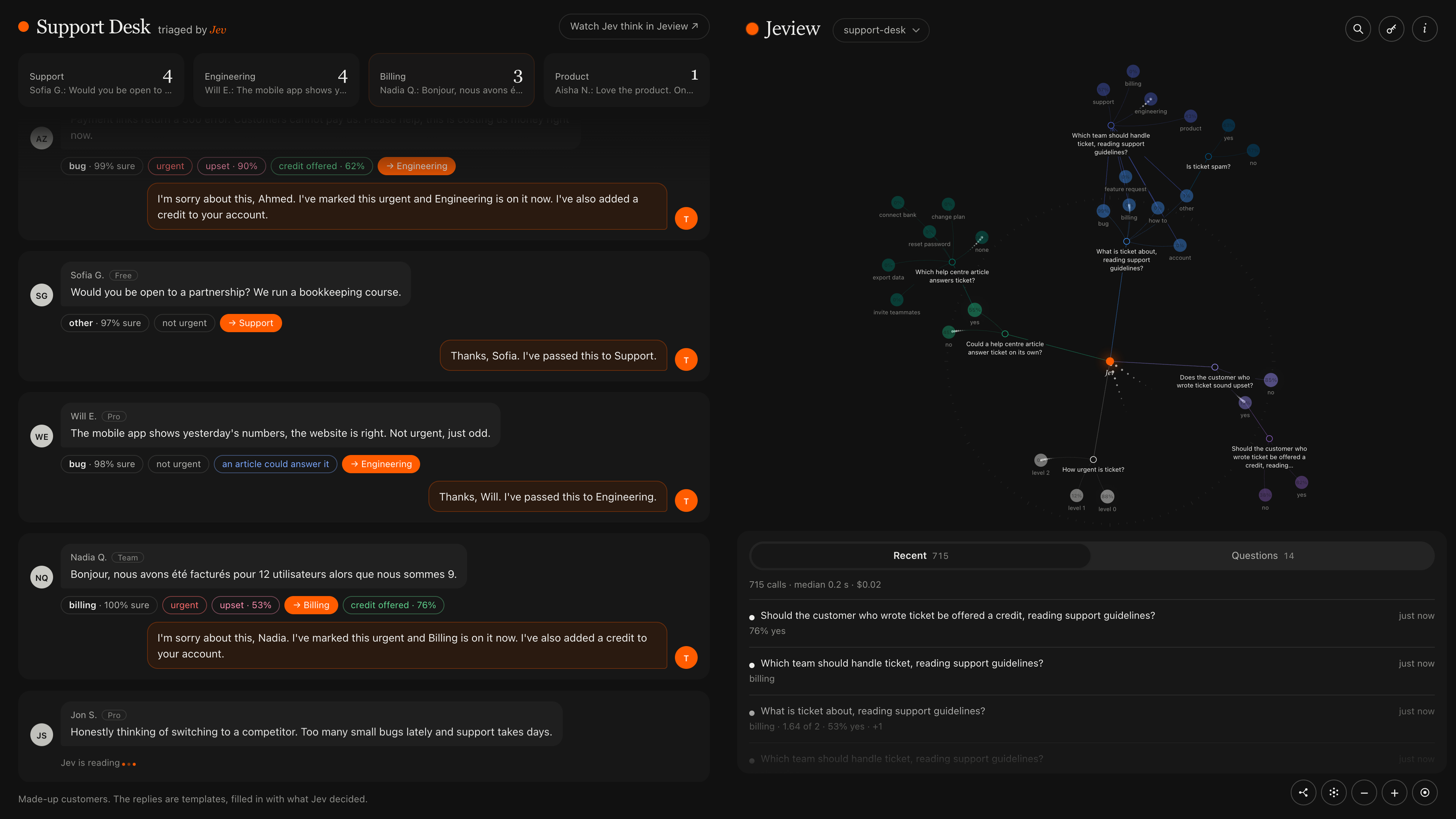
Jeview receives a host application’s Jev request at a local proxy, forwards the unchanged body to TypeSafe with the user’s key, and returns the answer. It records typed questions and answers in SQLite and adds event IDs so later Jev calls can identify the earlier answer that triggered them. The included support-desk demo asks Jev to route a ticket and conditionally make follow-up judgments.
Classify the ticket topic for routing.
Synthetic support guidelines and the current ticket sender, plan, and message.
Score how urgently the support ticket needs attention.
Synthetic support guidelines and the current ticket sender, plan, and message.
Decide whether the customer sounds upset.
Synthetic support guidelines and the current ticket sender, plan, and message.
Decide whether a help article may resolve the ticket.
Synthetic support guidelines and the current ticket sender, plan, and message.
A host app sends the request to Jeview’s local proxy, which forwards it to TypeSafe and returns the answer.
Jeview stores the typed request, answer, and an event ID locally.
The host can identify a triggering answer in a later request; the viewer shows the resulting branch.
The user opens the local viewer to inspect decisions and conditional paths.
It makes a multi-call Jev decision chain visible as a live map. A trigger header links conditional follow-ups to the answer that caused them without turning the visualizer into the application’s decision policy.