
 New
NewVector Graph RAG
Use Jev to rank graph relations and source passages before a language model answers a multi-hop question.
Added to Jevfast
NewUse Jev to rank graph relations and source passages before a language model answers a multi-hop question.
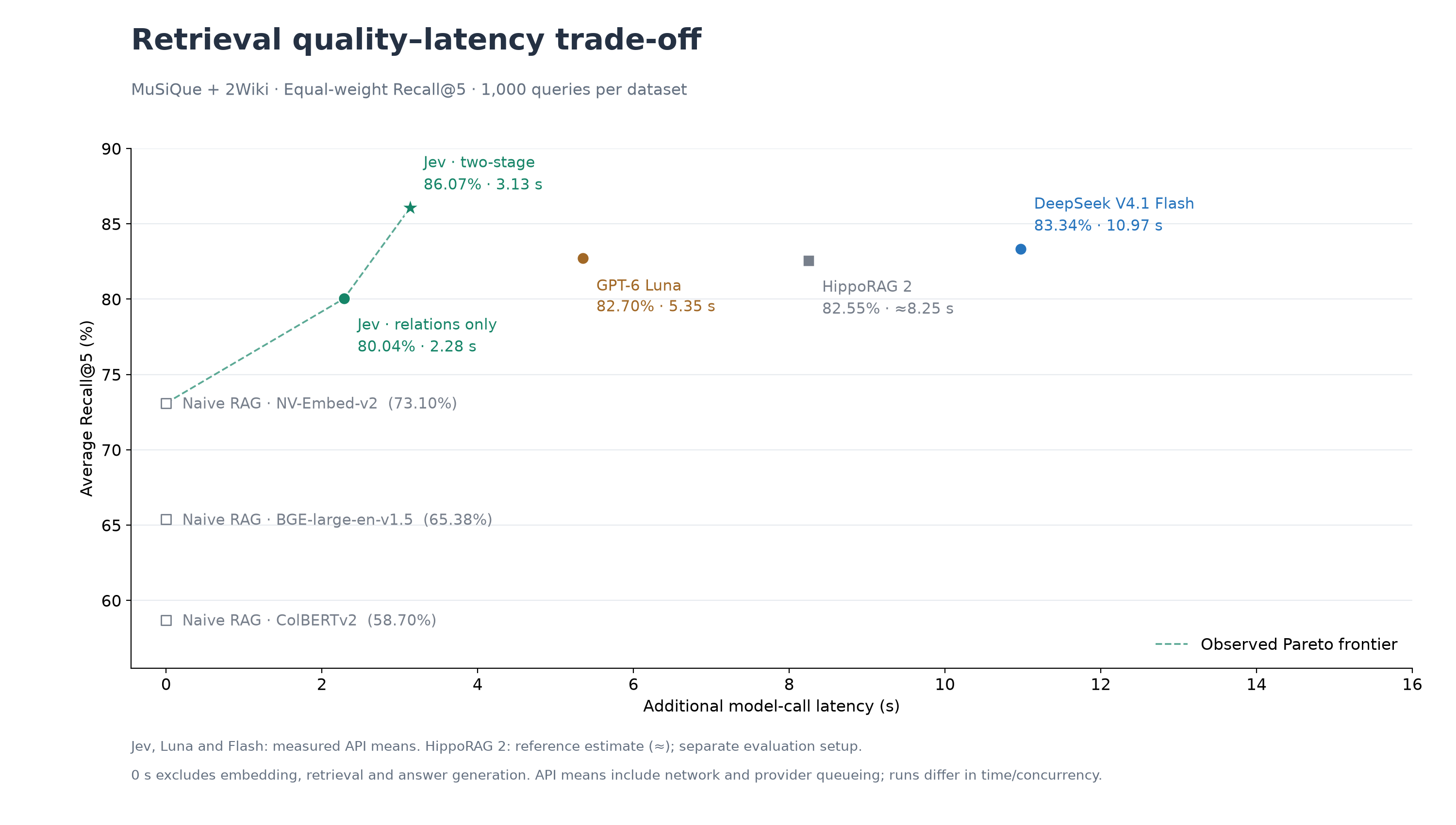
Jev scores candidate graph relations against the user's question and shared graph context. The highest-ranked relations seed source passages. A second set of Noul questions ranks up to 16 graph and dense-retrieval excerpts before the answer model uses the selected evidence.
Does this relation supply a needed fact or intermediate multi-hop link?
The user question and candidate_graph containing labeled relation IDs and text. One dynamic r{relation_id} question is generated per relation.
Does this target excerpt contain useful supported evidence for the question?
The user question and up to 16 excerpts keyed d0, d1 and so on.
Milvus vector retrieval finds entities and relations, then expands the candidate subgraph.
Jev Noul scores order the candidates; the top 64 relation seeds identify source passages.
Alternate graph passages with up to 10 dense candidates, deduplicate to at most 16, and score each excerpt with Jev.
Send the highest-ranked passages to the answer generator and return retrieval details.
Two bounded decision stages connect multi-hop graph facts with supporting source text. Each excerpt must support a useful fact itself; shared context alone does not make it relevant.