
 New
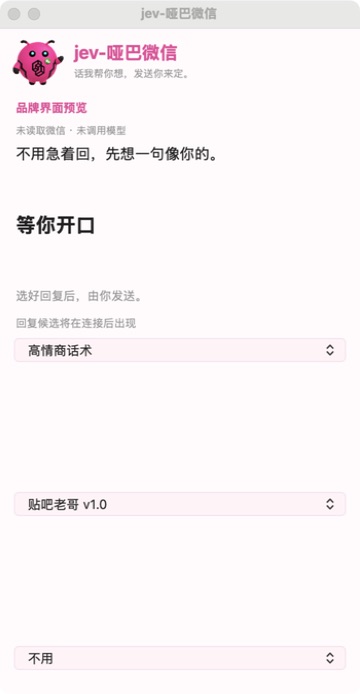
NewJev WeChat Reply Assistant
For a message and optional recent context, Jev receives two questions in one request: intent Choice and direct-reply-risk Score.
Added to Jevfast
NewFor a message and optional recent context, Jev receives two questions in one request: intent Choice and direct-reply-risk Score.
For a message and optional recent context, Jev receives two questions in one request: intent Choice and direct-reply-risk Score. The chosen intent maps to a static set of response actions. When GPT has generated reply candidates, a second dynamic Choice can rank them; that chart is omitted because concrete candidate texts are runtime-dependent.
What is the real intent of this message?
The state is the supplied message, prefixed by optional context and a blank line when context exists.
When read-screen mode is enabled, the app uses OCR on the local WeChat window; a detected message can trigger analysis.
Jev asks the two pinned questions together and the application maps the intent to static response guidance.
GPT generates reply text when configured; Jev does not generate the message.
The user selects a candidate, fills it into WeChat, checks it, and sends it.
The implementation separates semantic judgment from language generation: Jev labels intent and risk, while GPT writes candidate replies and Jev can select among them.